
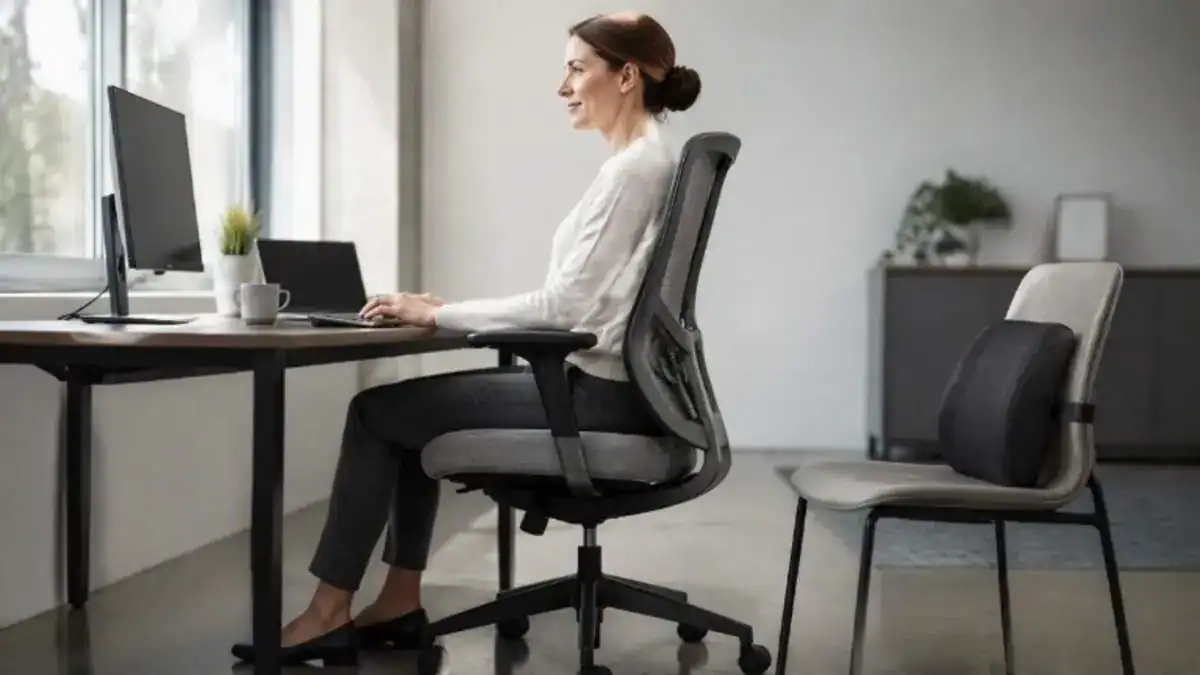
TL;DR
Key Takeaways
- The types of lumbar support come in several forms. No single design fits every person or chair.
- The broadest difference is built-in lumbar support vs external lumbar support. Built-in support is part of the chair, while external support is added to an existing seat.
- Built-in systems may use fixed, adjustable, or dynamic/responsive lumbar support.
- Fixed lumbar support uses a preset contour or depth. It works best when that shape matches the user’s lower back and sitting position.
- Adjustable lumbar support offers more customization. Depending on the design, support height, depth, or both may be changed to better match the user.
- Dynamic or responsive support is designed to accommodate changes in posture or chair use rather than remain completely static.
- External lumbar support options include memory foam cushions, inflatable supports, small cushions, and rolled towels. These can be useful when portability matters or a chair lacks suitable built-in support.
- Passive lumbar cushions and motion-restricting braces are not the same. Cushions provide passive support, while semi-rigid or rigid braces serve different stabilization or motion-restriction purposes.
- No lumbar support type is automatically best. Suitability depends on chair fit, body shape, support needs, customization, portability, and the sitting environment.
Quick Answer
The main types of lumbar support are built-in lumbar support and external or add-on lumbar support. Built-in support is part of the chair or backrest. External support is a separate option added to an existing seat.
The main lumbar support types include:
1. Built-in lumbar support:
- Fixed support
- Adjustable support
- Dynamic or responsive support
2. External lumbar support:
- Memory foam cushions
- Inflatable cushions
- Small cushions
- Rolled towels
Built-in systems may use a preset contour, allow adjustment, or respond to changes in posture or chair use. External lumbar support is removable and can often move between different chairs and sitting environments.
Semi-rigid and rigid back braces belong to a separate category. Ordinary lumbar cushions provide passive support while sitting. Braces can provide stabilization or restrict movement and may serve clinical purposes. They should not be treated as another type of everyday ergonomic lumbar cushion.
Table of Contents
When to Worry
While comparing lumbar support options, it is important to separate mild setup-related discomfort from symptoms that may need medical attention. Discomfort that changes with movement or chair adjustments may point to an ergonomic issue. Persistent, radiating, or severe symptoms should not be assumed to come from lumbar support alone.
Discomfort That May Need a Setup Check
A mild ache or stiffness may call for a setup check when it clearly follows sitting patterns.
Common clues include:
- a mild ache that improves with movement
- stiffness that eases after standing or walking
- discomfort that changes after adjusting the chair or lumbar support
- pressure that appears with a particular chair or lumbar-support type
These patterns may relate to chair fit, support position, or other ergonomic factors. By themselves, they do not show that a specific lumbar support type is causing a medical problem.
Signs That Need Professional Evaluation
Professional evaluation may be appropriate when pain does not improve after basic ergonomic changes or begins to affect normal activity.
Warning patterns include:
- pain lasting more than a few days
- pain or stiffness that limits normal movement or daily activities
- recurring sharp pain
- persistent pain on one side
- pain that spreads from the lower back toward the buttock or leg
These symptoms should not be managed simply by switching between different lumbar support options.
Urgent Warning Signs
Some symptoms need urgent medical evaluation rather than an ergonomic setup change.
These include:
- loss of bladder or bowel control
- numbness around the groin or saddle area
- severe or worsening leg weakness
- back pain with fever or unexplained weight loss
- back pain after a significant fall or injury
- worsening radiating pain with tingling, numbness, or electric sensations
When these warning signs occur, changing a chair or lumbar support should not replace appropriate medical evaluation.
Symptoms / Signs
Observable sitting patterns can show when a lumbar support does not seem to match the user or chair well. Useful clues include unwanted pressure, frequent shifting, loss of backrest contact, increasing slouching, and stiffness after long periods of sitting.
Pressure From a Support That Does Not Match the Back
A lumbar support may feel too prominent and create noticeable pressure against the lower back. A support that does not fill the natural curve well may instead leave the area feeling inadequately supported.
Another clue is discomfort that changes between chairs or lumbar supports. Pressure that appears with one support but not another can suggest that the support and the user’s lower-back shape do not match well.
Frequent Shifting or Loss of Backrest Contact
Frequent weight shifting can be a visible sign that the seated position does not feel comfortable or well supported. A person may also lean to one side or place more weight on one hip.
Some people move toward the front edge of the chair, which reduces contact between the lower back and backrest. Others may place a hand behind the lower back to create extra support.
Slouching as Sitting Continues
Lower-back rounding may become more noticeable as sitting continues. A person may find it harder to remain upright, especially during prolonged static sitting.
Lumbar contact may also decrease as the sitting position changes. Progressive tightness or fatigue can develop as the body stays in one position for too long.
Stiffness After Long Sitting
Stiffness may become noticeable when a person first rises after prolonged sitting. The lower back or hips may feel less flexible, but the stiffness may ease after standing or walking for a short time.
Another useful pattern is discomfort that improves with movement but returns after sitting resumes. This sitting-and-movement pattern can help show when discomfort is closely linked with prolonged sitting.
Causes: Why the Types of Lumbar Support Differ
The types of lumbar support differ because chairs, body shapes, movement needs, and support goals are not all the same. Some systems are built into the chair, while others are removable. They can also differ in adjustability, firmness, portability, and how they respond during sitting.
Chair Design Changes How Support Is Built
Chair design is one reason lumbar support takes different forms. Some chairs use chair-integrated lumbar support as part of the backrest. Other seats rely on external or add-on lumbar support placed between the lower back and the chair.
Built-in support usually stays with one chair, while external support can be removed and moved to another seat. Backrest shape and overall chair geometry also affect how much lumbar contour is already present and whether added support may be useful.
Different Backs Need Different Levels of Adjustment
Lumbar curves and body dimensions vary from person to person. Because of this, a fixed contour may fit one user well but feel too shallow or too prominent for another.
Adjustable lumbar support offers more flexibility. Depending on the chair, the support height, depth, or both may be changed to better match the user’s natural lumbar curve.
Support Can Stay Fixed or Move With the User
Fixed lumbar support stays in a preset position or contour. Adjustable support allows the user to change certain settings, such as height or depth.
Dynamic or responsive lumbar support is designed to accommodate changes in posture or chair use rather than act as a completely static support. However, available research does not support detailed claims that every dynamic system works the same way or performs better than fixed support.
Movement compatibility is therefore another reason different lumbar support types exist. Some designs remain stable, while others are intended to accommodate more changes in seated position.
Materials Change Firmness and Portability
Support materials also change how a lumbar option feels and how easily it can be moved. A built-in chair contour forms part of the backrest, while external options may use memory foam, air, or simple materials such as a small cushion or rolled towel.
Memory foam cushions usually provide passive, contoured support. Inflatable supports allow firmness to change through inflation and are often easier to carry between seats. Rolled towels and small cushions offer simple, portable support when a dedicated lumbar product is not available.
Support Functions Can Be Different
Not every product described as back or lumbar support serves the same purpose. Ordinary lumbar cushions mainly provide passive curve support while a person sits.
Semi-rigid and rigid orthoses serve a different role. They may provide more stabilization or restrict movement, placing them in a different category from ordinary ergonomic chair support. For that reason, braces should not be treated as simply stronger versions of lumbar cushions.
What It May Indicate
How a support feels or behaves can offer clues about whether it matches the person, chair, and sitting needs. These patterns do not diagnose a problem, but they can show when a different support approach may be more suitable.
A Fixed Support May Not Match the User
A fixed lumbar support uses a preset curve, position, or depth. That design can work well when the contour matches the user, but individual lumbar curvature and body dimensions vary.
If the support is too prominent, it may create unwanted pressure against the lower back. If it is too shallow, it may provide too little contact and fail to fill the natural lumbar curve well.
More Adjustability May Be Needed
More adjustability may be useful when one chair must fit different users or when a preset support does not match the body well. Adjustable lumbar support may allow changes in height, depth, or both.
Height affects where the support contacts the lower back. Depth affects how much the support fills the lumbar curve. Adjustable support may also be more practical when sitting positions change during the day.
An External Support May Be More Practical
External lumbar support may make more sense when a chair has no built-in support or when the existing contour does not provide enough contact. An external option can be added without replacing the whole chair.
Portability is another factor. Removable cushions and inflatable supports can move between office chairs, car seats, home seating, and travel seats. This may make them more practical for someone who uses several sitting environments.
A Brace Is Serving a Different Purpose
A lumbar cushion and a back brace should not be treated as interchangeable support options.
Lumbar cushions mainly provide passive support by helping fill or support the lower-back curve while sitting.
Semi-rigid and rigid orthoses can provide more stabilization or restrict movement. Their purpose and use context differ from ordinary ergonomic lumbar support, so a brace is not simply a stronger version of a lumbar cushion.
What to Do
Choosing between the types of lumbar support starts with the seat, the user, and the way the support will be used. The goal is not to find one universal “best” option. It is to match the support type to the chair, body dimensions, sitting environment, and support needs.
What to Compare Before Choosing a Support Type
Before comparing individual options, it helps to check the main factors that affect lumbar-support fit:
- Chair design
- Natural lumbar curve
- Body dimensions
- Height adjustment
- Depth adjustment
- Firmness
- Portability
- Movement needs
- Sitting environment
- Overall chair fit
Start With the Type of Seat Being Used
The first step is to check the type of seat. An office chair, home chair, car seat, or travel seat may provide very different levels of built-in lumbar support. For a car seat, lumbar support while driving can be adjusted as part of the overall driving position to improve lower-back contact and support.
If the seat already has a suitable built-in system, an extra cushion may not be needed. If the chair has little or no lumbar contour, an external support may be more practical.
Decide Whether Fixed or Adjustable Support Fits Better
A fixed support can work when its preset contour matches the user’s body and natural lumbar curve. It may be less suitable when the same chair must fit people with different body dimensions.
Adjustable support may be more useful when the support height or depth needs to change. Height affects where the support contacts the lower back, while depth affects how strongly it fills the lumbar curve.
Decide Whether Portability Matters
Permanent chair-integrated support stays with one seat. This can work well for regular use in the same office chair. Removable cushions, inflatable supports, small cushions, and rolled towels offer more portability.
They may be easier to move between a home chair, office chair, car seat, or travel seat. Inflatable support can be especially practical when travel or frequent chair changes matter because it offers variable firmness while remaining portable.
Match the Support Function to the Situation
Different lumbar support options can serve different purposes. Everyday lumbar cushions mainly provide passive support for the natural lower-back curve.
Adjustable systems provide more customization, while responsive systems are designed to accommodate changes in posture or chair use. Clinical braces and orthoses serve a different purpose by providing greater stabilization or restricting movement.
These categories should not be treated as interchangeable. A more restrictive support is not automatically a better ergonomic choice for everyday sitting.
Check the Whole Chair Before Blaming the Lumbar Support
Lumbar support does not work alone. Desk chair height and positioning can change how well the lower back contacts and uses the support.
Before deciding that the lumbar support is the problem, briefly check:
- seat height
- seat depth
- backrest contact
- recline
- armrest position
- foot support
A chair may have suitable lumbar support but still feel poorly matched if these other dimensions do not fit the user well.
Ergonomic & Support Options
The main lumbar support options can be grouped by how they are built, how much they can change, and how they are used. The broad groups include built-in chair systems, external add-on supports, and a separate clinical category for braces and orthoses.
Main Types of Lumbar Support at a Glance
The main types of lumbar support include:
1. Built-in / integrated support:
- fixed
- adjustable
- dynamic or responsive
2. External / add-on support:
- memory foam cushion
- inflatable support
- small cushion
- rolled towel
3. Separate clinical category:
- semi-rigid orthosis
- rigid brace
These groups should not be treated as identical. Built-in and external options mainly relate to everyday sitting support, while braces and orthoses can serve stabilization or motion-restriction purposes.
The table below compares the main ergonomic lumbar support options by design, adjustability, portability, use, and limitation.
| Type | Built-In or External | Adjustable? | Portable? | Main Use | Main Limitation |
| Fixed | Usually built-in | No | No | Simple everyday chair support | Preset contour may not match every user |
| Adjustable | Usually built-in | Yes | No | Customizable chair support | Requires a suitable adjustment range |
| Dynamic / responsive | Built-in | Varies by design | No | Support that accommodates changes in posture or chair use | Designs vary and should not be assumed superior |
| Memory foam cushion | External | Usually no | Yes | Passive support added to an existing seat | Cannot correct poor overall chair fit |
| Inflatable cushion | External | Firmness can be varied | Yes | Portable support across different seats | Inflation level needs to suit the user |
| Rolled towel / small cushion | External | Limited | Yes | Simple temporary external support | Less purpose-built and less consistent |
Built-In Lumbar Support
Built-in lumbar support is integrated into the chair or backrest. It does not require a separate cushion, which can make it convenient for regular desk use.
A built-in system may be fixed, adjustable, or part of a responsive design. Its usefulness depends strongly on chair fit, lumbar placement, and how well the contour matches the user.
Fixed Lumbar Support
Fixed lumbar support uses a preset position, curve, or depth. It has a simple design and can work well when the contour already matches the user’s lower back.
Its main limitation is that one fixed shape cannot match every body shape or lumbar curve. A support that is too shallow may provide too little contact, while one that is too prominent may create pressure points.
Adjustable Lumbar Support
Adjustable lumbar support allows more customization. Depending on the chair, support height, depth, or both may be changed to better match the user.
This can be useful when different people share the same chair or when individual lumbar curvature varies. Height changes where the support contacts the back, while depth changes how strongly it fills the lumbar curve.
Dynamic or Responsive Lumbar Support
Dynamic or responsive lumbar support is designed to accommodate changes in posture or chair use rather than remain completely static. It differs conceptually from fixed support that stays in one preset position.
Systems described with terms such as LiveBack or 4D lumbar may fall within this broader category.
However, the available source does not support a complete mechanism-by-mechanism comparison or claims that dynamic support always performs better.
External Lumbar Support
External lumbar support is added to an existing chair or seat. It can be useful when built-in support is missing, too shallow, or not adjustable enough.
Because it is removable, external support can move between office chairs, home seating, car seats, and other suitable seats. Cushions with straps may stay in position better than strapless designs.
Memory Foam Lumbar Cushions
Memory foam lumbar cushions are usually contoured and medium-firm. They provide passive support by filling some of the space between the lower back and backrest.
They can work with office chairs, home chairs, and some car seats. However, they are often less portable than inflatable options and cannot correct a poorly fitted chair by themselves.
Inflatable Lumbar Support
Inflatable lumbar support allows firmness to change by adding or removing air. This can be useful when support needs vary between seats or sitting situations.
Its main advantage is portability. An inflatable support can be practical for travel or for someone who regularly moves between different chairs.
Rolled Towel or Small Cushion
A rolled towel or small cushion can provide simple external support when a dedicated lumbar product is not available. It can help fill the natural lower-back curve without requiring a specialized accessory.
These options are simple and budget-friendly. Their usefulness still depends on whether they match the lower-back curve rather than simply adding padding behind the back.
Sacral Support Is Not the Same as Lumbar Support
Sacral support and lumbar support refer to different areas. Lumbar support targets the lumbar region of the lower spine, while sacral support relates more directly to the sacrum below it.
Some advanced seating systems combine both concepts. PostureFit SL is one example named in the source, but sacral support should not be treated as identical to lumbar-only support.
Lumbar Cushion vs Back Brace
A lumbar cushion mainly provides passive curve support during sitting. Its role is usually linked with ergonomic comfort and maintaining contact between the lower back and backrest.
A semi-rigid or rigid brace serves a different purpose. These devices may provide stabilization or restrict movement and belong to a different recovery or clinical context. A brace is not simply a stronger lumbar cushion.
Built-In vs External Lumbar Support
The main difference between built-in vs external lumbar support is integration. Built-in support is part of the chair, while external support is a removable addition.
Built-in support offers convenience and stays with one chair. External support offers more portability and can move between different seats.
Customization varies by design in both groups, so neither option is automatically better. Chair fit, support needs, and use context matter more than the category alone.
The main differences between built-in and external lumbar support are easier to compare side by side:
| Feature | Built-In | External |
| Integration | Part of the chair or backrest | Added separately to an existing seat |
| Portability | Usually stays with one chair | Can move between seats |
| Chair dependence | Strongly tied to chair design and fit | Can modify different compatible seats |
| Adjustment | May be fixed, adjustable, or responsive | Depends on the cushion or support design |
| Convenience | No separate accessory needed | Must be positioned and carried separately |
| Multiple-seat use | Limited | Usually more practical |
Fixed vs Adjustable Lumbar Support
The difference between fixed vs adjustable lumbar support is mainly preset shape versus customization. Fixed support uses a set contour or depth, while adjustable support can better account for individual differences.
Adjustable systems may allow changes in lumbar height, depth, or both. This can be useful in shared chairs or when one preset contour creates too little contact or too much pressure for some users.
Fixed vs Dynamic Lumbar Support
Fixed lumbar support stays in a preset position or contour. Dynamic or responsive support is intended to accommodate changes in posture or chair use.
The main conceptual difference is static behavior versus greater movement compatibility. Available research does not support the claim that dynamic support is universally better, so the comparison should remain cautious.
Adjustable vs Dynamic Lumbar Support
Adjustable and dynamic support describe different design ideas, and they can overlap. Adjustable lumbar support means the user can change settings such as height or depth.
Dynamic or responsive support means the system is intended to accommodate changes in posture or chair use. A lumbar system may include more than one of these characteristics.
Fixed vs Adjustable vs Dynamic Lumbar Support at a Glance
These three support designs differ mainly in how the support changes during use. The table below summarizes the differences without treating one design as automatically better.
| Support Type | How It Works | Main Advantage | Main Limitation | Best-Fit Situation |
| Fixed | Uses a preset position, curve, or depth | Simple and consistent | Cannot adapt to every body shape | When the preset contour already matches the user |
| Adjustable | Allows user-controlled changes such as height or depth | Greater customization | Depends on the available adjustment range | Shared chairs or users needing a closer individual fit |
| Dynamic / responsive | Designed to accommodate changes in posture or chair use | Greater movement compatibility | Designs vary, and superior outcomes should not be assumed | Users who change sitting position often |
Which Type May Fit Different Sitting Needs?
No single lumbar support type fits every situation. A useful comparison starts with how and where the support will be used. It also helps to understand how lumbar support helps posture before choosing between different designs.
- Regular office use: Built-in fixed or adjustable support may work when the chair fits the user well.
- Multiple users: Adjustable support may better accommodate different body dimensions and lumbar curves.
- Frequent chair changes or travel: Portable external or inflatable support may be more practical.
- Chair without enough lumbar contour: External lumbar support may add needed contact.
- People who move often while sitting: Responsive or dynamic systems may be relevant where available.
- Clinical stabilization: Semi-rigid or rigid orthoses belong to a separate category, and professional guidance may be appropriate for their use.
FAQ
What Are the Different Types of Lumbar Support?
The main types of lumbar support include built-in support and external support. Built-in systems may be fixed, adjustable, or dynamic/responsive. External options include memory foam cushions, inflatable supports, small cushions, and rolled towels.
How Do Different Types of Lumbar Support Compare?
Different types of lumbar support can be compared by integration, adjustability, firmness, portability, movement response, and chair dependence. Some stay built into one chair, while others can move between seats.
How Does Someone Choose a Type of Lumbar Support?
A suitable lumbar support type depends on chair design, body dimensions, natural lumbar curve, adjustment needs, portability, and sitting environment. No single feature should be judged on its own.
What Type of Lumbar Support Is Best?
There is no universal best type of lumbar support. The better fit depends on chair fit, body shape, support height and depth needs, portability, and how the seat is used.
Is Built-In or External Lumbar Support Better?
Neither built-in nor external lumbar support is automatically better. Built-in support offers convenience and stays with one chair, while external support offers more portability and can move between seats. Chair fit and use context matter most.
Is Fixed or Adjustable Lumbar Support Better?
Fixed lumbar support can work well when its preset contour matches the user. Adjustable lumbar support offers more flexibility because height, depth, or both may be changed. For shared chairs or different body shapes, adjustable support may be more practical.
What Is the Difference Between Lumbar Support Types?
The main difference is how each support works and how much it can change. Fixed support uses a preset contour. Adjustable support allows more customization. Dynamic support is designed to accommodate changes in posture or chair use, while external support is removable.
What Type of Lumbar Support Is Recommended?
The most suitable type is one that matches the user, chair, and sitting needs without creating unwanted pressure. Adjustable support may suit changing or shared-use needs, while portable external support may make more sense across different seats.
What Is the Difference Between Lumbar Support and Back Support?
Lumbar support focuses on supporting the natural curve of the lower back during sitting. “Back support” is a broader term and may also include products such as semi-rigid or rigid braces that provide stabilization or restrict movement. These should not be treated as the same as ordinary passive lumbar cushions.
Sources & References
- Comparison of postural changes and muscle fatigue between two types of lumbar support
- Comparison of trunk stiffness provided by different design characteristics of lumbosacral orthoses
- Lumbar Support Overview
- Lumbar supports for prevention and treatment of low back pain
- Ergonomic Chair Lumbar Support: Adjustable, Adaptive, and Fixed-Mechanism Comparison
- Lumbar Support Cushions: What the Evidence Actually Says
Soft CTA
After comparing the different types of lumbar support, these related guides can help readers understand how lumbar support works, where it should be positioned, and how chair fit affects overall support.
- What Is Lumbar Support? How It Works and Why It Matters – Learn what lumbar support is, how it supports the lower back during sitting, and why its shape and function matter.
- Where Should Lumbar Support Be? How to Position and Adjust It – See where lumbar support should contact the lower back and how positioning and adjustment affect support.
- Desk Chair Height and Positioning: A Step-by-Step Guide to Proper Adjustment – Learn how chair height, seat depth, backrest contact, and other chair settings work together with lumbar support and overall chair fit.
Update Note
Last Reviewed / Updated
Last reviewed: August 16, 2026.
This article was fact-checked for ergonomics guidance and information about the different types of lumbar support. It will be updated when meaningful research, lumbar-support designs, or chair-support technology changes.
1 thought on “Types of Lumbar Support: How Different Support Options Compare”
Comments are closed.