
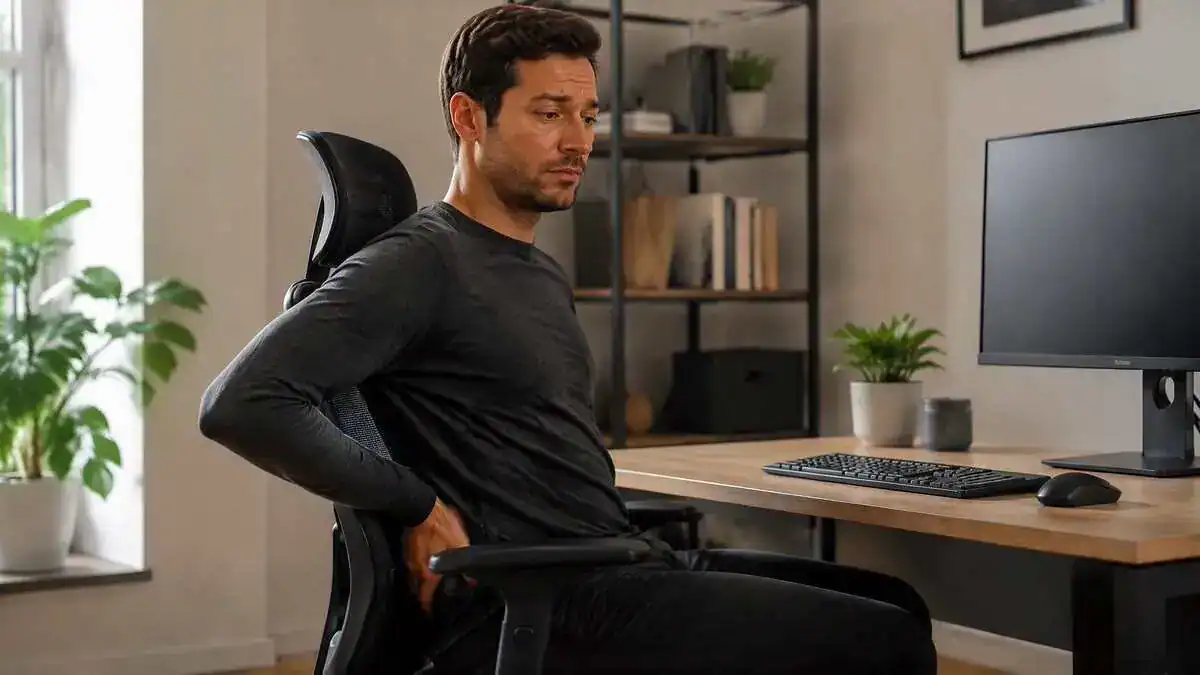
TL;DR
Key Takeaways
- Lumbar support may hurt when its shape, pressure, or contact does not fit the person well. Sitting posture and chair fit can also change how the support feels against the lower back.
- Pain while using lumbar support does not automatically mean the support has damaged the back. Research does not establish that lumbar support itself causes structural spinal harm.
- Mild soreness during the first few days with a new support is different from pain that persists or gets worse.
- Lumbar support cannot remove the effects of prolonged sitting. Staying in one position for too long may still lead to stiffness or discomfort, even with support.
- If the support feels uncomfortable, its contact with the person’s natural lumbar curve may need attention. Small differences in body shape can change where and how strongly the support presses against the back.
- Persistent or worsening pain needs more attention. Pain that spreads into the legs, numbness, tingling, weakness, symptoms after trauma, or other concerning changes may need professional medical evaluation rather than ergonomic changes alone.
Quick Answer
Why does lumbar support hurt my back? Lumbar support may hurt when it presses too strongly, does not match the person’s natural lumbar curve, or interacts poorly with sitting posture. Long periods of static sitting can also cause stiffness or discomfort even when the lower back has support.
A support that does not fit the body well may create pressure in one area or contribute to sliding and slumping. However, pain that starts while using lumbar support does not automatically mean the support has injured the back.
Persistent or worsening pain needs more attention. Pain that spreads into a leg, numbness, tingling, weakness, or pain after a fall, accident, or other trauma should not be treated only as an ergonomic problem and may need professional medical evaluation.
Table of Contents
When to Worry
When someone asks, “Why does lumbar support hurt my back?”, the pattern of discomfort matters. Mild soreness that settles is different from pain that persists, gets worse, spreads, or appears with other concerning symptoms.
Mild Discomfort That May Be Monitored
Some mild discomfort may be monitored at first. This can include general stiffness or soreness after sitting, mild discomfort during the first few days with a new lumbar support, or a low-level ache after a long sitting session.
A milder pattern often improves after changing position, moving around, or taking a break.
Signs That Need Professional Evaluation
Back pain deserves professional evaluation when it continues for several weeks despite reasonable ergonomic changes. Constant or intense pain, or pain that becomes worse at night or while lying down, also needs more attention.
The same applies when pain spreads into one or both legs or comes with numbness, tingling, or weakness. New back pain after age 50 may also need evaluation, especially with a history of cancer, osteoporosis, or long-term steroid use.
Signs That Need Prompt Medical Attention
Some symptoms should not be treated as ordinary discomfort from lumbar support. Prompt medical attention is appropriate when back pain follows a fall, car accident, direct blow, or other trauma.
Other warning signs include new bladder or bowel changes, difficulty urinating, or numbness around the genitals, buttocks, or inner thighs. This type of numbness is often called saddle numbness.
Fever with back pain, rapidly worsening leg weakness, a leg giving way, or severe pain with unexplained weight loss also needs prompt medical attention.
The main differences between mild discomfort and more concerning pain can be summarized this way.
| Pattern | Typical Context | Next Step |
| Mild adjustment soreness | May appear during the first few days with a new support | Monitor whether it settles |
| Persistent or worsening pain | Continues for several weeks or becomes more noticeable | Consider professional evaluation |
| Ordinary stiffness | Appears after sitting and improves with movement or a change of position | Break up long periods of sitting and monitor the pattern |
| Localized muscle tension | Stays mainly around the back | Monitor alongside sitting and ergonomic factors |
| Radiating or neurological symptoms | Pain travels into a leg or occurs with numbness, tingling, or weakness | Seek professional evaluation |
| Pain after trauma | Begins after a fall, accident, or direct blow | Seek appropriate medical attention |
| Urgent warning signs | May include bladder or bowel changes, saddle numbness, or rapidly worsening weakness | Seek prompt medical attention |
Symptoms / Signs
When someone wonders, “Why does lumbar support hurt my back?”, the discomfort may show up in several ways. Some signs stay in one area of the lower back, while others involve posture changes, stiffness, or symptoms that extend farther from the spine.
Local Pressure or Pinching
The support may feel as if it presses into one specific spot in the lower back. Some people notice pinching, uneven pressure, or discomfort that feels stronger on one side.
These signs may be especially noticeable where the back meets the lumbar support.
Sliding, Slouching, or Fidgeting
A person may keep sliding forward even while using lumbar support. Slouching can also appear, along with repeated shifting or fidgeting in the chair.
Another sign is difficulty settling into a comfortable seated position. The person may keep shifting because the support never feels quite right.
Stiffness After Sitting
Stiffness or aching may appear after a long sitting session. The lower back can also feel “stuck” for a short time when the person first stands up.
In some cases, discomfort builds slowly throughout the workday instead of starting all at once.
Symptoms That Extend Beyond the Lower Back
Lower-back discomfort may sometimes occur with neck tightness or shoulder tension when the overall sitting setup feels uncomfortable.
Numbness or tingling may also extend into the buttock or leg. These symptoms are different from pressure that stays only around the lumbar support area.
Driving-Related Discomfort
Lumbar-support discomfort can also appear during long drives. A driver may notice increasing lower-back discomfort as the trip continues. A comfortable lumbar support while driving setup also depends on how the support works with the car seat and driving position.
Signs the Support Setup May Need Attention
Several signs may appear when the lumbar support and sitting setup are not working comfortably together:
- Pressure concentrated in one spot
- Unequal pressure across the lower back
- Sliding forward while sitting
- Repeated shifting or fidgeting
- Difficulty settling comfortably against the backrest
- Discomfort that increases during prolonged sitting
Causes — Why Does Lumbar Support Hurt My Back?
When someone asks, “Why does lumbar support hurt my back?”, the reason is often related to fit, pressure, posture, chair contact, or long periods of sitting. Lumbar support can feel uncomfortable even when it is designed to support the lower back.
The Support Does Not Match the Person’s Lower-Back Curve
Lumbar curves differ from person to person. The height and depth of the natural inward curve are not the same for every body. Understanding how lumbar support works can help explain why its contact with the natural lower-back curve matters.
A support with the wrong shape or dimensions may press against an uncomfortable part of the lower back. This can be more noticeable with fixed or one-size-fits-all support that cannot adapt well to different body proportions.
This mismatch can explain why lumbar support hurts the back, feels uncomfortable, or seems to press in the wrong place.
The Support Creates Too Much Local Pressure
More support is not always better. A lumbar pad that pushes too far into the back can place extra pressure on a small area.
Instead of spreading contact more evenly, excessive depth or prominence may create concentrated pressure. This can make the support feel sharp, firm, or uncomfortable in one spot.
Sitting Posture Changes How the Support Feels
Lumbar support does not work separately from sitting posture. Slouching against the support, sitting away from the backrest, leaning to one side, crossing the legs, or sliding forward can all change how pressure reaches the lower back.
Poor or uneven backrest contact can lead to uneven lumbar pressure and localized discomfort.
Crossing the legs or leaning to one side may also make one side of the support press harder than the other.
Chair Fit Changes Lumbar Contact
The chair itself can change how lumbar support contacts the body. Seat height and seat depth can affect pelvic position, which can change where the support meets the lower back.
A lack of lumbar adjustability can make a poor fit harder to correct. The same chair may fit one person well but feel uncomfortable for another because body size and proportions differ.
Poor chair fit can therefore change pelvic position and backrest contact, increasing pressure in one area of the lower back.
Long Static Sitting Can Hurt Even With Support
Lumbar support does not remove the effects of prolonged sitting. Back pain from sitting too long can still develop stiffness or discomfort even when the chair feels supportive.
Sitting continuously for about 30–45 minutes or longer can allow the tissues behind the spine to gradually stretch under steady load. This process is often called spinal tissue creep.
The pattern can be described as:
Long static sitting → sustained lumbar flexion → posterior tissue creep → temporary loss of passive support → stiffness when standing
Lumbar support also does not fully prevent lumbar flexion during sitting. Research has found that substantial lumbar flexion can remain even when support is present.
Muscle Soreness or Fatigue May Feel Different From Pain
Mild soreness may appear during the first few days of using a new lumbar support. This may feel more like muscle fatigue or unfamiliar pressure than persistent pain.
Muscle fatigue and pain are not the same thing. Although passive support may reduce some active muscle effort, current evidence does not prove that this causes harmful muscle weakening.
Lumbar Support May Change Pelvic Position
Lumbar support can also influence the position of the pelvis. Its interaction with the backrest and seat pan may rotate the pelvis forward. This change can make seated posture look more upright or improve visible spinal alignment.
However, better-looking posture does not always mean the person will feel more comfortable.
How lumbar support affects posture and how comfortable it feels are not always the same thing. A setup can look more aligned while still feeling uncomfortable for that person.
The Pain May Not Be Coming From the Support
Back pain that appears while using lumbar support is not always caused by the support itself. Pain may come from an injury, a nerve-related problem, or another spinal issue that does not depend on sitting position.
Pain that spreads into the leg, especially with numbness, tingling, or weakness, follows a different pattern from localized ergonomic pressure.
Pain after a fall, accident, or direct blow also should not automatically be blamed on the chair or lumbar support.
What It May Indicate
When someone asks, “Why does lumbar support hurt my back?”, the pattern of discomfort can give clues about what may be happening. Local pressure, sliding, time-based stiffness, radiating symptoms, and pain after trauma do not all point to the same issue.
Localized Pressure May Point to a Support-Fit Problem
Pressure that stays in one small area may suggest that the support does not match the person’s body well. One-sided pressure can also appear when the shape, firmness, or contact point does not fit the lower-back curve evenly.
Individual body proportions matter. A support that feels balanced for one person may feel too firm or too concentrated for another.
Sliding Forward May Mean the Support and Sitting Position Are Working Against Each Other
Repeated sliding can suggest that the support, pelvis, and sitting position are not working together well.
The pattern may look like this:
Poor support and pelvis interaction → sliding forward → slumped posture → greater lower-back pressure
This does not prove that the support itself is the only problem. It shows that the way the body meets the chair may be part of the discomfort pattern.
Discomfort That Builds With Time May Be More About Static Sitting
Discomfort that slowly increases during a desk session may point to prolonged sitting as part of the problem.
Lumbar support cannot remove the effects of staying still for long periods. Even with support, static sitting can increase stiffness and spinal loading over time.
If discomfort is mild at first but becomes more noticeable as sitting time increases, movement and sitting duration may be important parts of the pattern.
Why Does Lumbar Support Hurt My Back Even When the Chair Seems Ergonomic?
An ergonomic chair does not guarantee a good fit for every person. Body shape, lumbar-support geometry, posture, and time spent sitting can still affect comfort.
A chair may look well designed and still feel wrong for that body. Equipment can support more comfortable sitting, but it cannot guarantee comfort on its own.
Radiating Symptoms May Point Beyond an Ergonomic Problem
Localized muscle tension or pressure is different from symptoms that travel beyond the lower back.
Pain that extends down a leg, especially with numbness, tingling, or weakness, should not simply be interpreted as “bad lumbar support.” These symptoms follow a different pattern and may need professional evaluation.
Pain After Trauma Is a Different Pattern
Back pain that begins after a fall, accident, or direct blow has a different meaning from discomfort that builds gradually during sitting.
This type of pain should not be reduced to a chair-fit or lumbar-support issue. Pain after trauma may need prompt medical attention.
The table below shows how different discomfort patterns may be interpreted without assuming that lumbar support is always the cause.
| Pattern | What It May Suggest | What It Does Not Prove |
| Localized pressure | Support shape, firmness, or contact may not fit well | That the lower back has been injured |
| One-sided discomfort | Pressure may be uneven or the support may not match the body evenly | That lumbar support itself is causing spinal damage |
| Sliding forward | The support, pelvis, and sitting position may not be working well together | That the support is the only problem |
| Stiffness after long sitting | Static sitting may be contributing to discomfort | That lumbar support has failed or caused injury |
| Radiating symptoms | The pattern may extend beyond a simple ergonomic pressure problem | That lumbar support is necessarily the cause |
| Discomfort after trauma | The pain may need medical attention rather than ergonomic troubleshooting alone | That chair fit explains the symptoms |
What to Do
When someone asks, “Why does lumbar support hurt my back?”, the next step is to respond to the pattern rather than force the same setup. A few simple checks can help separate pressure-related discomfort from symptoms that need more attention.
Reduce or Stop the Aggravating Support Temporarily
If the lumbar support clearly makes the discomfort worse, the person does not need to keep forcing contact with it. Reducing the pressure or temporarily stopping use can help show whether the support is contributing to the problem.
If the discomfort settles when the pressure or contact changes, that pattern is useful to notice. This does not mean every person needs to stop using lumbar support permanently.
Identify the Discomfort Pattern First
Before changing several things at once, it helps to work through the problem in a simple order:
- Stop forcing a setup that clearly makes the discomfort worse.
- Identify whether the discomfort involves pressure, stiffness, sliding, or symptoms that extend beyond the lower back.
- Check whether the lower back makes comfortable contact with the backrest and support.
- Consider whether chair fit is changing how the lumbar support contacts the body.
- Break up long periods of static sitting with regular movement.
- Reassess whether the discomfort settles, stays the same, or gets worse.
- Seek professional evaluation when symptoms persist or warning signs appear.
Recheck How the Support Contacts the Lower Back
The lower back should make comfortable contact with the support rather than staying far away from the backrest. Sitting too far forward can reduce that contact and change how the support feels.
The pressure should feel gentle rather than sharply concentrated in one area. If the support feels as if it is pushing into one spot, its contact with the lower back may need attention. The guide to where lumbar support should be positioned explains placement and adjustment in more detail.
Change Position and Move Regularly
Lumbar support should not be used as a reason to stay in one position for long periods. Brief standing or walking breaks can help break up static sitting.
A brief standing or walking break about every 30–45 minutes can help reduce long periods without movement. General movement throughout the day also matters, not just scheduled desk breaks.
Check the Chair as Part of the Problem
The chair can affect how the lower back meets the lumbar support. Feet should have support, while desk chair height and positioning, seat depth, and backrest contact should allow the person to sit without being pushed away from the support.
Poor chair fit can change pelvic position and lumbar contact, so the support itself may not be the only part that needs attention.
Seek Professional Evaluation When the Pattern Does Not Settle
Professional evaluation may be appropriate when back pain continues for several weeks despite reasonable ergonomic changes. Persistent or worsening symptoms should not simply be treated as a chair or lumbar-support problem.
If symptoms extend beyond ordinary sitting discomfort or any of the warning signs described earlier appear, medical evaluation may be appropriate.
Ergonomic & Support Options
When someone asks, “Why does lumbar support hurt my back?”, the type of support is only one part of the picture. Fit, shape, firmness, backrest contact, chair dimensions, and regular movement can all affect how comfortable the lower back feels.
Adjustable Lumbar Support May Fit Better Than Fixed Support
A fixed lumbar support stays in the same position and may not match every person’s lumbar curve. Differences in body size and the height or depth of the lower-back curve can make fixed support press against an uncomfortable area.
Adjustable support offers more flexibility to match individual body proportions. However, it is not automatically more comfortable for everyone. Comfort still depends on how well the support, chair, and body work together.
The main difference is how much flexibility each type provides when the support does not fit the person well.
| Feature | Fixed Support | Adjustable Support |
| Fit flexibility | Limited by its built-in shape and position | Offers more flexibility to match the person |
| Lumbar height/depth matching | May not match individual lumbar dimensions | May allow a closer match |
| Localized pressure | May occur when the fixed design does not fit the body | Greater adjustability may help improve contact |
| Body-size differences | One design may not suit every body proportion | Can provide more flexibility across different body proportions |
Support Shape and Firmness Matter
Two lumbar supports can feel very different even when they contact a similar area. Body proportions, support shape, firmness, and the way pressure spreads across the lower back all affect comfort.
A support that is too firm or concentrates pressure in a small area may feel uncomfortable. A shape that fits one person well may not suit another because lumbar curves and body proportions vary.
Backrest Contact Matters as Much as the Pad
Lumbar support can provide its intended contact only when the lower back actually meets the backrest or support.
Sitting far forward reduces that contact and changes how the support functions. Without comfortable backrest contact, the support may not work as intended.
Chair Height and Seat Depth Can Change Support Pressure
Chair fit can change where lumbar pressure is felt. Seat height and seat depth influence pelvic position and how the lower back meets the backrest.
If the chair does not fit the person well, the pelvis may shift and the lumbar support may contact a different part of the lower back than intended.
Lumbar Support Cannot Replace Movement
Even well-fitting lumbar support cannot remove the effects of prolonged sitting. Staying in a static posture for long periods can still contribute to stiffness and discomfort.
Regular movement remains important because lumbar support is only one part of sitting ergonomics. A supportive chair does not make long periods without movement harmless.
Support Type May Matter When the Fit Is Poor
Different support designs offer different amounts of flexibility:
- Fixed support stays in one built-in position and may not match every lumbar curve.
- Adjustable support allows more flexibility in matching the support to individual body proportions.
- External support adds a separate support surface, such as a removable lumbar cushion, instead of relying only on the chair’s built-in support.
The different types of lumbar support vary in how they provide support and adjust to different sitting needs. No single support type is best for everyone. A better fit depends on the person’s body, the chair, and how comfortably the support contacts the lower back.
FAQ
These common questions give short answers for people wondering “Why does lumbar support hurt my back?” or why lumbar support feels uncomfortable during sitting.
Can Lumbar Support Cause Back Pain?
Yes. Lumbar support may contribute to back discomfort when its fit, pressure, or contact with the lower back does not suit the person. However, pain while using lumbar support does not automatically mean it has injured the spine.
Why Does My Lumbar Support Feel Uncomfortable?
A lumbar support may feel uncomfortable when its shape, depth, or firmness does not match the person’s natural lumbar curve. Body proportions and sitting position also affect where and how strongly the support contacts the lower back.
Is Lumbar Support Supposed to Hurt?
Persistent or sharp pain is not the goal of lumbar support. Some people may notice mild soreness during the first few days of using a new support. However, pain that persists or gets worse deserves more attention.
How Is Lumbar Support Supposed to Feel?
Lumbar support should feel like gentle, supportive contact against the lower back rather than sharp or concentrated pressure. It should support the natural lumbar area without creating a strong pressure point that makes sitting harder to tolerate.
Can Too Much Lumbar Support Hurt Your Back?
Yes. A support that projects too far into the lower back may create concentrated pressure and localized discomfort.
More lumbar support is not automatically better. Comfort depends on how well the support matches the person’s body and distributes pressure.
Can Lumbar Support Hurt Your Back?
Yes. Lumbar support can feel painful or uncomfortable when it presses in the wrong area, creates concentrated pressure, or does not match the person’s body well.
Feeling pain while using the support does not, by itself, prove that an injury has occurred.
Why Is Lumbar Support Hurting My Back?
Common reasons include poor support fit, too much pressure, a mismatch between the chair and body, changes in sitting posture, or long periods without movement.
The discomfort may come from one factor or several factors working together.
Is Lumbar Support Supposed to Be Uncomfortable?
Lumbar support may feel unfamiliar at first, but a person should not need to tolerate ongoing discomfort just to keep using it.
Mild early soreness and persistent pain are different patterns. Discomfort that continues or worsens should not simply be dismissed as normal adjustment.
Sources & References
- Lumbar Supports for Prevention and Treatment of Low Back Pain
- Spine Biomechanics of Prolonged Sitting
- Back Pain: When to See a Doctor
- Sciatica
- When to See a Doctor for Back Pain
- Effectiveness of Lumbar Support in Management of Low Back Pain
Soft CTA
For readers who want to understand lumbar support beyond why it may hurt the back, these guides explain placement, how lumbar support works, and what it can realistically do for posture.
- Where Should Lumbar Support Be? How to Position and Adjust It
- What Is Lumbar Support? How It Works and Why It Matters
- Does Lumbar Support Help Posture? What It Can and Cannot Do
Update Note
Last Reviewed / Updated
Last reviewed: August 29, 2026
This article may be updated as research on lumbar support, sitting ergonomics, and medical guidance for back pain changes.
8 thoughts on “Why Does Lumbar Support Hurt My Back? Causes, Warning Signs, and What to Do”
Comments are closed.