
TL;DR
Key Takeaways
- Hip pain when sitting can have several possible contributors. Sitting may aggravate a sensitive area without being the underlying cause of the pain.
- Long, uninterrupted sitting keeps the hips bent while placing pressure through the buttocks and thighs. Limited position changes may also allow stiffness or discomfort to build.
- Chair fit can matter. A low or hard seat, one-sided sitting, repeated reaching, or staying in an uneven position for too long may make symptoms worse for some people.
- Where the pain occurs and how it changes with sitting, standing, or walking can provide useful clues. However, these patterns cannot confirm the cause.
- Changing position, reducing direct pressure, improving basic chair fit, and keeping the body moving within comfort may help reduce sitting-related aggravation.
- A problem that changes with a certain chair, pressure, or sitting position may have an ergonomic trigger. Pain that persists, worsens, affects normal function, or occurs across different settings may need medical evaluation rather than ergonomic changes alone.
- Neurological symptoms, significant injury, fever or swelling, or major loss of function need appropriate evaluation. Urgent warning signs should not be delayed while testing changes to a chair, posture, or cushion.
Quick Answer
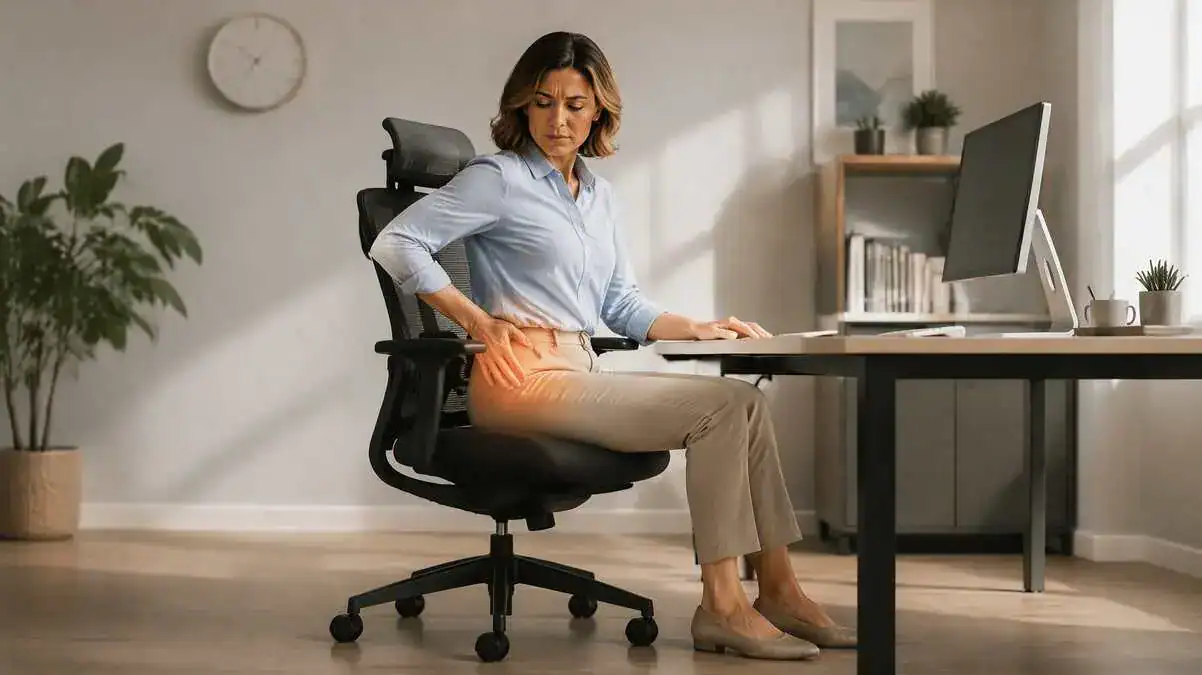
Hip pain when sitting may be related to prolonged pressure, sustained hip flexion, muscle or tendon sensitivity, poor chair fit, a hip-joint problem, or pain referred from the lower back. The pain may develop while sitting, become noticeable after sitting, or appear when first standing up.
Simple changes may help when sitting clearly aggravates the discomfort. A person can reduce long periods of uninterrupted sitting, vary position, keep the feet supported, check seat height and depth, and avoid direct pressure that makes symptoms worse.
Persistent or worsening pain needs more attention, especially when it affects walking, sleep, or normal activities. Neurological symptoms, fever or swelling, major trauma, or an inability to bear weight require medical evaluation rather than relying only on ergonomic adjustments.
Table of Contents
When to Worry
When Hip Pain Needs Professional Evaluation
Hip pain when sitting deserves professional evaluation when it keeps returning, gets worse, or starts limiting normal activities. Pain that has not improved after about two weeks of sensible self-management, or that begins to affect sleep or usual activities, also needs more attention.
Other warning patterns include:
- sitting tolerance that keeps decreasing
- a persistent limp
- reduced hip movement
- painful clicking, catching, or locking
- ongoing difficulty getting into a car
- recurrent or worsening numbness, tingling, radiating pain, or weakness
- persistent groin, outer-hip, or sitting-bone pain even after reducing the activity or pressure that aggravates it
- prominent stiffness after rest
- morning stiffness lasting more than 30 minutes
- hip pain following an injury, especially when there is a higher risk of fracture
These patterns do not identify the cause on their own. However, persistent pain, loss of movement, neurological symptoms, or declining function should not be explained by sitting habits alone.
When Urgent Assessment Is Needed
Some symptoms need urgent medical assessment rather than waiting to see whether the hip pain improves. This is especially important when severe pain follows an injury or when walking, movement, nerve function, or general health changes suddenly.
Urgent warning signs include:
- severe hip pain after a fall, collision, or other injury
- inability to walk or bear weight
- inability to move the leg
- visible deformity
- sudden major swelling
- a hot, swollen, or discoloured hip with fever or chills
- feeling very unwell along with hip symptoms
- sudden severe hip pain without an obvious injury
- new or rapidly worsening weakness
- foot drop
- major loss of feeling
- numbness around the saddle area, including the buttocks, genitals, anus, or inner thighs
- new bladder or bowel changes
- severe neurological symptoms affecting both sides
Saddle-area numbness, new bladder or bowel problems, or rapidly worsening leg weakness can signal a time-sensitive nerve problem and require emergency assessment.
Symptoms and Signs
Where Hip Pain When Sitting Is Felt
Hip pain when sitting can be felt in different areas around the hip. A person may notice pain at the front of the hip or in the groin, along the outer hip, deep in the buttock, or around the sitting-bone region.
The location can provide a useful clue, but it cannot identify the cause by itself. Similar pain locations can occur with different problems, so location should be considered along with other symptoms and how the pain behaves.
How the Pain May Feel
The sensation can range from mild discomfort to more noticeable pain.
A person may describe it as:
- a dull ache
- pressure
- stiffness
- soreness
- sharp pain
- burning
- tingling
- numbness
- a shooting or radiating sensation
A dull ache or pressure can occur with sustained loading around the hip. Burning, tingling, numbness, or shooting pain has a different pattern and may suggest nerve involvement, especially when the sensation travels into the thigh or leg. The feeling alone, however, cannot confirm the cause.
Symptoms During and After Sitting
Hip pain while sitting may build gradually the longer a person remains seated. Some people notice hip stiffness after sitting, while others mainly feel discomfort when they first stand or during the first few steps.
The pattern may also change with movement. Hip pain after sitting may ease after changing position or walking for a short time. A person may repeatedly shift, recline, or stand because staying seated becomes uncomfortable.
Over time, the amount of time a person can sit comfortably may decrease. This reduced sitting tolerance can become noticeable during desk work, driving, flights, meetings, or other activities that involve long periods of sitting.
Changes in Movement or Daily Activity
Hip symptoms may also affect normal movement. A person may begin to limp, take shorter steps, or notice a reduced range of motion. Stairs may become harder, and putting on shoes may become uncomfortable.
Other signs can include difficulty getting into or out of a car, painful clicking, catching, or locking, and trouble sleeping comfortably. Some people may also cut back on work, recreation, or other daily activities because of the discomfort.
These changes can be more meaningful than the pain label alone. Hip pain that begins to affect walking, movement, sleep, or everyday activities has a greater functional effect than brief discomfort that settles after a position change.
Hip Pain Patterns at a Glance
A few common patterns can help a person describe hip pain when sitting more clearly. These clues may help show what deserves more attention, but they cannot diagnose the cause.
| Pattern | What a Person May Notice | What It May Suggest | When to Get More Help |
| Front/groin | Deep ache, stiffness, pain with bending or rising | Possible hip-joint involvement | Persistent limitation, limp, or painful locking |
| Outer hip | Tender side of hip, pain when rising or lying on that side | Lateral hip sensitivity | Persistent pain or walking difficulty |
| Deep buttock/sitting bone | Local pressure pain or hard-seat sensitivity | Tendon, bursa, deep-gluteal, or referred source | Persistent focal pain or neurological symptoms |
| Burning/tingling | Radiating or spreading sensation | Possible nerve involvement | Recurring or worsening numbness or weakness |
What Causes Hip Pain When Sitting?
Hip pain when sitting can have several possible causes or aggravating factors. Sitting may create pressure or loading that makes a sensitive area hurt without being the underlying medical cause.
A chair, sitting position, or long period of sitting may therefore trigger symptoms without explaining why the area became sensitive in the first place.
Prolonged Sitting and Limited Position Changes
Prolonged sitting keeps the hips bent for an extended time. It also places sustained pressure through the buttocks and thighs while giving the body fewer chances to change position. An ache or stiffness may gradually build as the sitting period continues.
This helps explain how sitting can contribute to hip pain without being the only cause. A long seated position may aggravate an already sensitive hip joint, tendon, bursa, or deep-buttock structure.
The pattern can follow a simple chain:
Prolonged sitting → sustained pressure and limited position changes → local sensitivity or stiffness → pain when first standing.
For this reason, hip pain from prolonged sitting or hip pain from sitting too long may become more noticeable after a long desk session, drive, meeting, or other period of limited movement.
Sitting can aggravate hip pain, but the symptom pattern alone does not show whether sitting is the underlying cause.
A Chair That Does Not Fit Well
An ill-fitting chair can change pressure, support, and hip position. A hard seat may concentrate pressure near the sitting bones, while a seat that is too narrow may leave too little room for comfortable hip movement.
Seat depth also matters. If the seat is too deep, the backrest can become difficult to reach. A person may then perch forward or slouch, increasing muscular effort and creating uneven pressure around the hips.
A seat that is too high may leave the feet unsupported or create pressure behind the thighs. A low seat can increase hip bending and make standing require more effort. Checking chair height and positioning can help show whether the seat is supporting the body appropriately. This may make front or outer-hip symptoms more noticeable when rising.
Worn or poorly supportive seating can add to these problems. In each case, the chair may aggravate discomfort without necessarily being the underlying cause of the hip problem.
Sitting Unevenly for Too Long
Uneven sitting can place more pressure or load on one side of the body. Common examples include leaning to one side, crossing the legs, sitting on a wallet, tucking one foot underneath the body, repeatedly reaching to one side, or twisting toward an off-centre task.
The concern is not one brief “bad posture.” The more relevant pattern is staying in an unsupported or uneven position for a long time or repeatedly returning to the same one-sided position.
The pattern may develop as:
One-sided or crossed-leg sitting → uneven pressure and hip position → irritation in a sensitive area → discomfort during sitting or after standing.
So, can bad posture cause hip pain? Sustained or repeated uneven sitting may contribute to hip discomfort, but posture alone does not prove that it caused an underlying hip condition.
Muscle or Tendon Sensitivity
Hip muscles and tendons may become sensitive after fatigue, mild strain, or changes in activity.
Long periods of inactivity may also reduce how well the body tolerates sustained sitting. The opposite pattern can occur after a sudden increase in running, cycling, lifting, stair use, or sport.
The added workload may overload muscles, tendons, or nearby tissues, making both sitting and movement uncomfortable.
The proximal hamstring tendon near the sitting bone can also become sensitive to load and compression. When this happens, sitting may aggravate a deep, localized area near the lower buttock or sitting bone.
Pressure Around the Outer Hip or Sitting Bone
Some hip pain involves tissues around the outer hip or sitting bone. Greater trochanteric pain syndrome affects the outer-hip region and often involves the gluteal tendons and sometimes a nearby bursa. Prolonged sitting or direct pressure may aggravate this sensitive area.
Ischial bursitis affects a small bursa near the sitting bone. Repeated pressure, especially on a hard surface, may irritate this area and cause a deep ache or tenderness where the body contacts the seat.
Hip-Joint Problems
Some hip-joint problems can become more noticeable during or after sitting. Hip osteoarthritis, femoroacetabular impingement (FAI), and labral irritation or tears are examples.
Hip osteoarthritis may involve groin or deep-hip aching and stiffness after sitting or resting. FAI may become uncomfortable with deeper hip flexion or rotation, while labral problems can sometimes involve pain or mechanical symptoms in certain seated positions.
Long periods of sitting, deeper hip bending, twisting, rising from a low seat, or getting into and out of a car may make these symptoms easier to notice. These patterns can provide clues, but they cannot identify a specific joint problem on their own.
Pain Referred From the Lower Back or Nerves
Pain felt around the hip does not always begin in the hip itself. The lumbar spine can refer pain toward the hip, while sciatic nerve-root irritation may cause symptoms that travel from the lower back or buttock into the thigh or leg. Understanding back pain from sitting may also help when lower-back discomfort occurs alongside the hip symptoms
Sensitivity around the deep gluteal or piriformis region may also become worse with prolonged sitting.
The pattern can develop as:
Deep-buttock sensitivity + prolonged sitting → local pressure or irritation → sciatic-type symptoms → burning, tingling, numbness, or pain into the leg.
However, deep buttock pain does not automatically mean sciatica. Several structures can produce pain in this area, so spreading nerve-type symptoms and localized buttock discomfort should remain distinct.
Injury or Other Medical Causes
Hip pain may also follow a strain, tendon injury, labral injury, fracture, or dislocation. Other possible medical causes include inflammatory arthritis, infection, and less common serious conditions.
Pain felt near the hip can also come from nearby areas. Abdominal, pelvic, sacroiliac, or other structures may refer pain toward the hip region. These causes cannot be identified from sitting position or chair response alone.
What It May Indicate
Patterns of hip pain when sitting can give useful clues about what area may be sensitive or what type of loading may be aggravating the symptoms. These patterns can guide further attention, but they cannot confirm a diagnosis on their own.
Front or Groin Pain May Point Toward the Hip Joint
Pain at the front of the hip or in the groin is more suggestive of possible hip-joint involvement than pain felt only over the outer hip or sitting bone. It may occur with problems such as hip osteoarthritis, femoroacetabular impingement, or labral irritation.
Clues may include a deep ache, stiffness, limited hip movement, or discomfort with deeper bending or rising. However, location alone cannot identify the cause because muscular and referred pain can also be felt around the groin or front of the hip.
Outer-Hip Pain May Reflect Lateral Hip Sensitivity
Outer-hip pain may point toward sensitivity in the tissues along the side of the hip. A person may notice tenderness when pressing the area or discomfort when lying on that side.
The same area may also hurt during walking or after rising from a low chair. This pattern can occur with lateral hip sensitivity, but these signs do not confirm one specific condition.
Deep Buttock or Sitting-Bone Pain May Be Pressure Sensitive
Deep buttock or sitting-bone pain can follow several overlapping patterns. A pinpoint ache or tenderness may become more noticeable with direct pressure, especially on a firm or hard seat.
Possible sources include sensitivity around the sitting bone, a nearby bursa or tendon, deep gluteal tissues, or pain referred from the lower back. The location gives a clue, but it does not show which structure is responsible.
Not every deep-buttock symptom should be called sciatica. Local pressure pain and neurological pain can overlap, but they are not the same pattern.
Burning, Tingling, or Pain Down the Leg May Involve a Nerve
Burning, tingling, numbness, shooting pain, or symptoms that travel from the buttock into the thigh or leg may suggest possible nerve involvement. This can include referred pain from the lumbar spine or a sciatic-type pattern.
These symptoms deserve more attention when they spread, keep returning, become more intense, or occur with weakness. A brief tingling sensation that fully settles after repositioning is different from neurological symptoms that recur or worsen.
Pain When Standing Up May Reflect Stiffness or a Provoked Hip Position
When someone asks, “Why does my hip hurt when I get up from sitting?”, several patterns are possible. Hip pain when standing up from sitting may reflect stiffness after rest, outer-hip sensitivity, or symptoms that became more noticeable while the hip remained bent.
A low seat can place the hip in deeper flexion and make standing require more effort. Longer periods of sitting can also allow stiffness or sensitivity to build, so hip pain after sitting may be most noticeable during the first movement or first few steps.
This pattern does not point to one diagnosis. Its meaning depends on the pain location, how long it lasts, whether movement helps, and whether other symptoms are present.
Pain That Improves After Walking May Suggest Sitting Is an Aggravator
If discomfort eases after standing, walking, or changing position, sitting may be acting as an aggravating factor. This pattern can suggest that prolonged pressure, a sustained position, or reduced movement is contributing to the symptoms.
However, improvement after walking does not prove that the chair or posture is the underlying cause. Ergonomic factors may modify symptoms even when another hip, tendon, joint, or nerve problem is present.
Pain Across Many Chairs May Mean the Problem Is Not Mainly Ergonomic
A useful distinction is whether the symptoms closely follow one sitting setup or appear across many situations.
The comparison below can help show whether the pattern is more closely linked to sitting or whether it may need further evaluation.
| More Consistent With Sitting/Setup Aggravation | Needs More Evaluation |
| Changes with chair or position | Occurs across many settings |
| Improves after repositioning | Progressive or persistent pain |
| No trauma or systemic signs | Fever, swelling, or injury |
| Normal walking and function | Limp, weakness, or reduced function |
Ergonomics can still influence either pattern. However, symptoms that occur across different settings or continue to worsen should not automatically be blamed on sitting posture or chair fit.
What to Do
When hip pain when sitting seems linked to long or awkward sitting, the first goal is to reduce aggravating exposure without becoming completely inactive. Position changes, comfortable movement, and simple habit changes can also help reveal what makes the symptoms better or worse.
Change Position Before the Hip Gets Very Stiff
A person does not need to stay in one position until the hip becomes painful or very stiff. It may help to stand briefly, walk, recline, change sitting position, or switch to a different task before discomfort builds.
A brief position change about every 30 minutes can serve as a practical starting habit. It is not a universal medical sitting limit. The timing should vary based on symptoms, work demands, and individual tolerance.
The aim is not to push through steadily increasing discomfort. Instead, the person can avoid staying in one static position for longer than the hip comfortably tolerates.
Reduce Direct Pressure
Long periods on hard surfaces may increase pressure around the buttocks or sitting-bone region. A person with pressure-sensitive discomfort may benefit from reducing how long that area remains loaded in the same way.
Simple steps include removing a wallet or other object from a back pocket and avoiding positions that place direct pressure on a tender sitting-bone area. Varying pressure and position is usually more useful than staying fixed on one side.
Reduce One-Sided Sitting Habits
Repeated one-sided sitting may keep the hips in an uneven position for too long. A person can periodically uncross the legs, avoid keeping one foot tucked underneath the body, and reduce habitual leaning to one side.
After reaching or twisting toward an off-centre task, it can also help to return to a more centred position. The goal is not to hold one “perfect” posture but to avoid staying in the same uneven position for long periods.
Keep Moving Within Comfort
Comfortable general movement is usually more useful than unnecessary complete inactivity. A gradual return to normal movement may also make sense after a long inactive period or when symptoms follow a sudden increase in activity.
Movement should stay within a comfortable range. A person should stop if it causes sharp pain, spreading numbness, weakness, or clearly worsening symptoms. A specific stretching routine or exercise program is not necessary to make these basic changes.
Track What Changes the Symptoms
Tracking one factor at a time can make patterns easier to understand. Useful details include:
- where the pain is felt
- how long the person was sitting
- which chair was used
- what activity or task was being done
- what changed the symptoms
- whether numbness or tingling occurred
- whether symptoms occurred at night
- whether walking changed the symptoms
This can help show whether a certain chair, position, task, or sitting duration repeatedly brings on symptoms. It can also help separate a repeatable ergonomic trigger from ordinary day-to-day variation.
Get Professional Help When the Pattern Is Unclear
When the pattern remains unclear, keeps returning, or function starts to decline, a qualified clinician may help assess what is contributing to the problem.
An assessment may include:
- gait
- hip movement
- spinal movement
- strength
- neurological signs
- work tasks
- chair fit
The purpose is to look at the full pattern rather than assume the discomfort comes only from posture, the chair, or the hip itself.
Ergonomic & Support Options
For hip pain when sitting, ergonomic changes should focus on basic fit, support, pressure, and position variation. The goal is not to create one perfect posture. A useful setup should support the body while still allowing comfortable movement and position changes.
Quick Chair-Fit Check
A few basic checks can show whether the chair provides enough support and room for comfortable sitting:
- Are the feet supported?
- Is the seat shallow enough to use the backrest comfortably?
- Is there enough room for the hips and thighs?
- Is there any hard seat-edge pressure?
- Can the backrest be used comfortably?
- Is the main work within comfortable reach?
Check Seat Height and Foot Support
The feet should rest firmly on the floor or on a stable footrest. When the seat is at a suitable height, the knees may sit roughly level with or slightly below the hips. Exact angles should not be treated as strict rules because body proportions and tasks differ.
If the feet are unsupported, a person may slide forward, shift position, or lean to find stability.
These changes can alter how pressure passes through the hips and thighs.
Check Seat Depth and Hip Room
Seat depth should allow a person to sit back and use the backrest while keeping some clearance behind the knees. A seat that presses into the calves or makes the backrest difficult to reach may encourage forward perching.
The seat should also provide enough width for the hips to change position comfortably. Armrests and seat edges should not crowd the thighs or pelvis. Limited hip room can restrict movement and make it harder to vary pressure during long periods of sitting.
Use the Backrest Without Forcing One Position
A usable backrest can support the lower back and reduce the need to hold the trunk upright with constant muscular effort. It should also allow a person to recline or change position rather than locking the body into one fixed posture. A supported sitting position can provide a useful starting point while still allowing regular position changes
There is no single “perfect posture” that must be maintained all day. Supported variation is more realistic than rigidly holding one position, especially during longer periods of sitting.
Bring the Work Closer to the Body
The main work should stay in front of the body when possible. A keyboard, mouse, phone, and other frequently used items should be close enough that a person does not need to repeatedly lean or twist to reach them.
Adequate legroom also matters. Boxes, equipment, or other objects under the desk should not force the hips, knees, or feet into an uneven position. A complete ergonomic desk setup can help coordinate these workstation elements so the body does not have to keep reaching or twisting
Can Lumbar Support Help Hip Pain?
Lumbar support may help some people use the backrest more comfortably and reduce unsupported slumping. This can improve the overall sitting position without requiring the person to hold the trunk rigidly.
However, lumbar support should not push the body forward or make hip symptoms worse. It can influence backrest use and sitting behavior, but it is not a treatment for every cause of hip pain.
When a Seat Cushion May Help
A firm, supportive cushion may help when direct sitting-bone pressure is a clear aggravating factor. The aim is to redistribute pressure more comfortably rather than simply add more softness.
More padding is not automatically better. A cushion can:
- raise the effective seat height
- change how the body lines up with lumbar support
- reduce sitting stability
- create pressure in another area
- alter the overall chair fit
If a cushion increases pain or makes the sitting position feel unstable, it should not be continued. A cushion is a support option, not proof of a diagnosis or a treatment for every hip condition.
Standing Can Add Variety, but It Is Not a Complete Fix
Standing can add useful position variety and reduce time spent in prolonged static sitting.
Switching between supported sitting, standing, and brief movement can reduce how long the body stays in one position. However, prolonged sitting should not simply be replaced with prolonged static standing. The broader goal is regular position variation rather than relying on one posture for the whole day.
FAQ
Why Does My Hip Hurt When I Sit?
Hip pain when sitting may happen because sitting combines hip flexion with pressure through the buttocks and thighs. This can make a sensitive hip joint, tendon, bursa, or deep-gluteal area more noticeable. Pain may also be referred from the lower back. The symptom alone cannot identify one specific cause.
Can Sitting Too Long Cause Hip Pain?
Long, uninterrupted sitting may contribute to hip discomfort because it combines prolonged pressure, sustained hip flexion, and limited movement. An ache or stiffness may build over time, especially when an area is already sensitive. There is no universal amount of sitting that causes hip pain for everyone because tolerance varies by person and situation.
Why Does My Hip Hurt After Sitting?
Hip pain after sitting may become noticeable when pressure or stiffness builds during the seated period. Standing changes the load on the hip and may make a sensitive area more noticeable during the first few movements. Brief stiffness that eases after changing position differs from persistent or worsening stiffness that affects normal activity.
Why Does My Hip Hurt When I Get Up From Sitting?
Pain when getting up from sitting may relate to stiffness after rest, outer-hip sensitivity, or deeper hip flexion in a low chair. Low seating also requires more effort to stand. These patterns can make hip pain when getting up from sitting more noticeable, but they do not identify one diagnosis.
Why Does My Hip Hurt When I Sit but Not Walk?
If hip pain develops while sitting but improves after standing or walking, sitting may be an aggravating exposure. Pressure, sustained hip flexion, or staying in one position may contribute. However, relief with movement does not prove that the chair or posture is the underlying cause.
Can a Bad Chair Make Hip Pain Worse?
Yes. An ill-fitting chair may make hip pain worse by increasing pressure, leaving the feet unsupported, limiting hip room, or encouraging forward perching. A seat that is too deep, too narrow, or too low can also change how the hips are loaded. However, chair fit does not explain every case of hip pain.
Is Numbness While Sitting Serious?
Brief tingling caused by pressure that fully settles after repositioning may be less concerning. Recurrent, spreading, or worsening numbness needs professional evaluation, especially when it occurs with weakness or symptoms down the leg. Saddle-area numbness or new bladder or bowel changes are emergency warning signs.
What Is a Red Flag for Hip Pain?
Red flags include severe pain after an injury, inability to bear weight, a hot or swollen hip with fever, sudden severe pain, or rapidly worsening weakness. Saddle-area numbness and new bladder or bowel changes also need emergency assessment. Persistent worsening pain, limping, or neurological symptoms should also be medically evaluated.
Can Sitting Cause Hip Pain?
Sitting can contribute to hip pain, but it may act as an aggravator rather than the underlying cause. A chair, posture, or long sitting period may increase pressure or keep the hip in one position long enough to bring on symptoms. Improvement after changing position does not prove that sitting caused the original problem.
Can Bad Posture Cause Hip Pain?
Sustained uneven or unsupported sitting may contribute to or aggravate hip discomfort. Examples include leaning to one side, crossing the legs, or repeatedly twisting toward a task. One brief imperfect posture does not explain every case, and posture should not be treated as a diagnosis.
Sources & References
The information about hip pain when sitting, symptom patterns, warning signs, possible medical contributors, chair fit, posture, and ergonomics was informed by the following research and medical sources:
- Hip Pain in Adults — NHS
- Hip Pain: Causes — Mayo Clinic
- Hip Pain in Adults: Evaluation and Differential Diagnosis — American Family Physician (AAFP)
- Hip Pain: When to See a Doctor — Mayo Clinic
- Ischial Bursitis — Cleveland Clinic
- Piriformis Syndrome — Cleveland Clinic
- Sciatica — OrthoInfo, American Academy of Orthopaedic Surgeons (AAOS)
- Hip Osteoarthritis — OrthoInfo, American Academy of Orthopaedic Surgeons (AAOS)
- Femoroacetabular Impingement (FAI) — OrthoInfo, American Academy of Orthopaedic Surgeons (AAOS)
- Hip Labral Tear — Johns Hopkins Medicine
- Hip Bursitis — OrthoInfo, American Academy of Orthopaedic Surgeons (AAOS)
- Proximal Hamstring Tendinopathy — Calderdale and Huddersfield NHS Foundation Trust
- Office Ergonomics: Ergonomic Chair — CCOHS
- Computer Workstations eTool — OSHA
- Choosing an Ergonomic Chair — Cornell University Ergonomics
- Cauda Equina Syndrome — North Bristol NHS Trust
These sources support the article’s broad pain-pattern guidance, ergonomic fit principles, and warning-sign information. Symptom patterns can help guide safer next steps, but they cannot confirm a diagnosis on their own.
Soft CTA
For readers who want to better understand the factors that can affect hip pain when sitting, these related guides explain prolonged sitting, chair fit, and lower-back support in more detail.
- Back Pain From Sitting Too Long – Useful for readers whose discomfort builds mainly during prolonged sitting.
- Desk Chair Height and Positioning – Useful when chair fit, unsupported feet, seat depth, or desk-chair coordination appears relevant.
- What Is Lumbar Support? – Useful for readers who want to understand the role and limits of lower-back support while sitting.
Update Note
Updated: September 14, 2026
This article was updated after reviewing research on hip pain when sitting, including symptom patterns, warning signs, chair-fit factors, sitting behavior, and ergonomic support considerations.
9 thoughts on “Hip Pain When Sitting: What May Be Causing It and What to Do”
Comments are closed.